
Tuesday, 15 October 2019
Charting change in Asian Landscapes: Festival of Ideas, Cambridge University Library, Saturday 26th October


Friday, 21 June 2019
SAALG Summer meeting in Cambridge, 25 July 2019
Cambridge University Library will be the venue for our summer meeting this year, and we will be viewing South Asian material from the Royal Commonwealth Society's Fisher and COVIC archives, as well as rare maps and plans from the University Library's Map Department.
Follow links for information on the Fisher photograph collection, and the Papers of the Colonial Office Visual Instruction Committee.
Sabrina Meneghini will share some of her research. Do read her blog posts of 19 January 2018 and 12 April 2018.
We will be hosting a larger exhibition of work from this archive entitled 'Classroom Photographic Journeys' in the Alison Richard Building, West Road, Cambridge 20 April - 29 May 2020. Please make a note in your 2020 diary!
Our summer meeting on 25th July will commence at 2 pm, and finish around 5pm.
Spaces will be limited, so if you haven't yet confirmed your attendance, please contact Rachel Rowe (rcs @ lib.cam.ac.uk with the subject line: 'SAALG 25 July 2019') if you plan to attend.
Looking forward to seeing you on Thursday 25th July.
Rachel Rowe
Smuts Librarian for South Asian & Commonwealth Studies
University of Cambridge
Friday, 14 June 2019
Job Vacancy: Research Associate (Persian Collections), John Rylands Library
The John Rylands Research Institute wishes to appoint a Research Associate to work on the University of Manchester’s world-class Persian Manuscript Collection. The successful candidate is expected to hold a Ph.D. in Persianate studies or a related area, ideally dealing with Persian book culture, possess an excellent command of Persian and Arabic and have extensive experience of cataloguing manuscripts in Persian scripts.
For more information and to apply see:
For more information and to apply see:
Thursday, 9 May 2019
New Open Acccess publication - Early Modern India: Literatures and Images, Texts and Languages
Interested in Indian vernaculars, Persian, Sanskrit? In the relations between various yogic traditions? Then please have a look at the newly released Early Modern India: Literatures and Images, Texts and Languages, edited by Maya Burger and Nadia Cattoni.
This book presents recent scholarly research on one of the most important literary and historical periods of the Early Modern era from a wide range of approaches and perspectives. It contains a selection of contributions presented at the 12th International Conference on Early Modern Literatures of North India which provide fresh and new material as well as innovative methods to approach it. The organizing principle of the volume lies in its exploration of the links between a multiplicity of languages (Indian vernaculars, Persian, Sanskrit), of media (texts, paintings, images) and of traditions (Hindu, Jain, Sikh, Muslim). The role of the Persian language and the importance of the translations from Sanskrit into Persian are discussed in light of the translational turn. The relations between various yogic traditions, especially of Nath origin, from Kabir and other sampradayas, are reconsidered.
Burger, Maya and Nadia Cattoni (eds.). Early Modern India: Literatures and Images, Texts and Languages. Heidelberg; Berlin: CrossAsia-eBooks, 2019. - 358 p. with coloured illustrations. ISBN (PDF) 978-3-946742-46-3; ISBN (Hardcover) 978-3-946742-45-6. https://doi.org/10.11588/xabooks.387

Tuesday, 7 May 2019
Spears collection in the Centre of South Asian Studies
Over 80
books and 74 boxes of papers were bequeathed by T.G.P. Spear 1901–1982) to the
Archives of the Centre. The papers include reprints of Spear's articles for the
fifteenth edition of Encyclopaedia Britannica, 1974 and his research notes. The
book collection includes works published in the eighteenth and early nineteenth
centuries.
Dr
(Thomas George) Percival Spear was a Lecturer at St Stephen's College, Delhi
1924-40 and held various posts in Ministry of Information and Broadcasting,
Government of India 1940-45 and was subsequently Bursar of Selwyn College,
Cambridge 1945-70 and Lecturer in History, Cambridge University 1963-69.
His
publications (held in the Centre) include:
Delhi :
its monuments and history, 1943
Twilight
of the Mughuls : studies in late Mughul Delhi, 1951
India : a
modern history, 1961
Master of
Bengal : Clive and his India, 1975
The
Oxford history of modern India, 1965 2nd ed 1978
India
remembered 1981
 |
| Archive SPE 1-4 |
 |
| Archive SPE 2-7 |
Archive SPE 19 The history of Hindostan; : from the earliest account of time, to the death of Akbar; translated from the Persian of Mahummud Casim Ferishta of Delhi: ... With an appendix, containing the history of the Mogul empire, from its decline in the reign of Mahummud Shaw, to the present times. / By Alexander Dow. In two volumes. London : printed for T. Becket and P. A. de Hondt, 1768, which is also held in the Parker Library of Corpus Christi College,
 |
| Archive SPE 13-18 |
 |
| Archive SPE 4 |
and unique to Cambridge but has been digitized from an American edition by the Hathi Trust Archive SPE 4 Grant, Colesworthey, 1813-1880. Lithographic sketches of the public characters of Calcutta, Calcutta : W. Thacker & Co, 1850, containing presscuttings and a useful summary of the characters illustrated.
 |
| Archive SPE 4 |
Monday, 25 March 2019
Challenges in the preservation of Lahore’s archives: a researcher’s perspective
I am delighted to
publish this post by Mobeen Hussain, PhD
candidate in the Faculty of History at the University of Cambridge.
During my summer research trip to Pakistan in 2018, I
visited many local archives and libraries which provided a snapshot of the
archival and scholarly landscape of Lahore. I visited the Punjab State Archives and Civil
Secretariat Library, the Pakistan Research Society at the Punjab University,
Punjab Public Library, the Quad-i-Azam Library and the National College of Arts
(formerly Mayo School of Industrial Arts).
Getting to grips with content:
Visiting Lahore for the first
time meant that I was able to observe numerous researcher and archival
challenges; challenges that local users are aware of and have to contend with
on a daily basis. Upon arrival at the Punjab State Archives, I met with the
archives’ director, Mohammed Abbas Chughtai, who explained that the archive and
its libraries have received fewer visitors after the events of 9/11 due to
concerns about safety in the country. The archive does, however, receive some
non-native and international scholars, and the research officer and director
were eager to help as well as point visitors in the direction of other useful
resources. The Punjab State Archives and the associated Civil Secretariat
Library boast of lengthy Persian and Urdu collections as well as administrative
documents from the Punjab during British colonial rule. I learnt much about the
archive culture in Lahore by taking time to talk to academics, fellow researchers,
archivists and librarians who were pleased to receive scholars in their
institutions. Speaking to archivists and librarians is a must— they know
their materials best. I would also advise researchers to take some time speak
to fellow Lahore-based researchers and academics at local universities
including the Lahore University of Management Sciences (LUMS) and Punjab University.
Local scholars often know about the research potential across the city, about new
books published in Pakistan (particularly by the Oxford University Press based
in Karachi) and other places of interest.
Handlists,
Catalogues and Digitisation:
Due to limited
funding and resources, many South Asian libraries and archives do not have
intuitive online catalogues or websites. If they have a website, such as the
Punjab State Archives, it can be unwieldy and only highlight key points of
interest in the archive (and not reflective of the content held). However, many institutions have handlists including the
Civil Secretariat and Punjab Public Library. These are by no means exhaustive
but are useful in order to take stock of what an archive holds and helps to
narrow and focus a search. The Punjab State Archive has announced its digitisation project and recruited digitisers, but the project is yet to start and the archive is waiting on lengthy administrative processes
to obtain more funding.

Heat and humid
conditions:
The climate of
Pakistan presents its own preservation pressures. The heat and humidity,
despite the use of fans (and, at times, air conditioning) as cooling methods,
results in brittle paper that is prone to easy wear and tear and the rapid
accumulation of dust.
Space and building
issues:
When discussing the
preservation of archives in Pakistan, Saamia Ahmed, the associate professor in
charge of the archives at the National
College of Arts, noted that
finding space was one of the biggest challenges facing small and local
archives. Indeed, the Civil Secretariat library has a handlist of English-language
colonial-era books, but numerous items went missing as a result of numerous
relocations of collections. Researchers just have to try their luck but I
definitely recommend a visit as the current location is library aficionado’s
dream.
Consulting materials:
A few of the
libraries and archives I visited did not have many handling restrictions. The
use of pens was not prohibited, and fans and drinks were vital for users in the
summer heat but could easily contribute to the damaging of records. The limited
restrictions were useful when viewing and handling full records and taking
photographs. However, in order to help maintain records for future, researchers
should not take advantage of this and handle material with care (taking note of
best practice at other institutions). Both researchers and archivists
have a responsibility to think about long term preservation and how best to
attract visitors to use their vast materials.
Of course, it is important to bear in mind that many of
these archives are still young compared to institutions like the British
Library in London. Most Lahori archives and libraries run on limited funding and
resources. Therefore, sharing knowledge practice with other national archives
like the National Archives of Pakistan in Islamabad and international
organisations would be useful. Some of this collaborative work has been done
but needs to continue in order to preserve and make the most of these rich
resources.
Other useful resources on South Asian archives:
The Archives of
Economic Life in South Asia https://www.histecon.magd.cam.ac.uk/archives-asia/blog.html
A Review of Three Archives in Pakistan http://dissertationreviews.org/archives/12520

Image: Punjab State Archives in the Tomb of Anarkali, Civil
Secretariat (author’s own photograph).
Tuesday, 12 March 2019
New open access journal - Dastavezi: The Audio-Visual South Asia
The first volume of the new open access journal Dastavezi: The Audio-Visual South Asia is out !
 Dastavezi: The Audio-Visual South Asia
is a journal for scholars and filmmakers, filmmakers as scholars, and
filmmaking scholars working on regional and transregional South Asia.
The journal provides a platform for linking audio-visual and scholarly
practice from and on South Asia.
Dastavezi is an offer of CrossAsia within the DFG funded project FID Asien. The journal is hosted by Heidelberg University Library in cooperation with the South Asia Institute at Heidelberg University.
Dastavezi: The Audio-Visual South Asia
is a journal for scholars and filmmakers, filmmakers as scholars, and
filmmaking scholars working on regional and transregional South Asia.
The journal provides a platform for linking audio-visual and scholarly
practice from and on South Asia.
Dastavezi is
an open-access archive of audio-visual knowledge. By providing films
published in the journal with Digital Object Identifier (DOI) numbers, Dastavezi
encourages filmmakers and scholars working on South Asia to cite
documentary film as a legitimate source of academic production.
Furthermore, it aims to make the films accessible to audiences beyond
the structures of the market domain. Through linking the production of
audio-visual material with the filmmaker’s own conceptual writing we
hope to widen the horizons of the existing field of documentary
film-studies, visual-anthropology, and film practices on and from South
Asia.
The first issue includes an introduction by the main editors, Max Kramer and Jürgen Schaflechner, and films and essays by:
- Fathima Nizaruddin. My Mother’s Daughter (19:05). Delhi.
- Mahera Omar. Perween Rahman: The Rebel Optimist (1:06:57). Karachi.
- Yaminay Chaudhri. Mera Karachi Mobile Cinema (22:22). Karachi.
- Aditya Basu. Kaifiyat (8:13). Mumbai.
Further information on the journal can be attained from
and
Submissions (film-links and essays) should be sent to:
An Economist's Collection in Cambridge - Austin Robinson
The work of entering the books held in the Archive Collection of the Centre of South Asian Studies onto the online catalogue continues.
Austin Robinson (Sir Edward Austin Gossage Robinson 1897-1993) was Professor of Economics at the University of Cambridge from 1950 to 1965, one of the founders of the Economic Faculty and Fellow of Sidney Sussex between 1931 and 1993. The Economic Faculty building at Cambridge is named after him.
In the 1980s he gave to the Archives of the Centre of South Asian Studies four boxes of economic papers from 1926-1980 concerning India, Pakistan and Bangladesh,
and a collection of books, some of which are still held in the main library of the Centre and fifteen in the Archives sequence. Other more general books were given to Sidney Sussex College and can be found by using the keywords Provenance: bequeathed by Sir Austin Robinson on iDiscover
From 1926-28, when he went to India soon after marrying Joan (nee Maurice), he tutored the young Maharajah of Gwalior. In his mid-seventies he was Senior Adviser to the United Nations Advisory Team to ASEAN (the Association of South East Asian Nations).
Archive ROB 1 is a biography by H.M. Bull of Madhav Rao Scindia of Gwalior 1876 -1924 Gwalior : A.D. Press, 1926), the father of Robinson’s tutee. Archive ROB 13 is The Gwalior Annual Civil List : compiled in the Finance member's office Gwalior and published by authority, corrected up to 30th June 1927. (Lashkar : Alijah Darbar Press, 1927) and, unique to Cambridge, is
Archive ROB 5

Hindu fairy tales by Dewan Sharar, illustrated by Ernest Aris. (London : George G. Harrap, 1936.)
Other books in the collection reflect a general interest in India such as :
Rob 7 Dewar, Douglas Indian birds : being a key to the common birds of the plains of India. (London : John Lane, 1923), Rob 9 Frazer, R.W. Literary history of India. (London : T. Fisher Unwin, 1898) which, along with Rob 10 Wilson, H.H. Select specimens of the theatre of the Hindus. (London : Parbury, Allen & Co., 1835) had previously belonged to Mary C. Wilde his Great Aunt.
Austin Robinson (Sir Edward Austin Gossage Robinson 1897-1993) was Professor of Economics at the University of Cambridge from 1950 to 1965, one of the founders of the Economic Faculty and Fellow of Sidney Sussex between 1931 and 1993. The Economic Faculty building at Cambridge is named after him.
In the 1980s he gave to the Archives of the Centre of South Asian Studies four boxes of economic papers from 1926-1980 concerning India, Pakistan and Bangladesh,
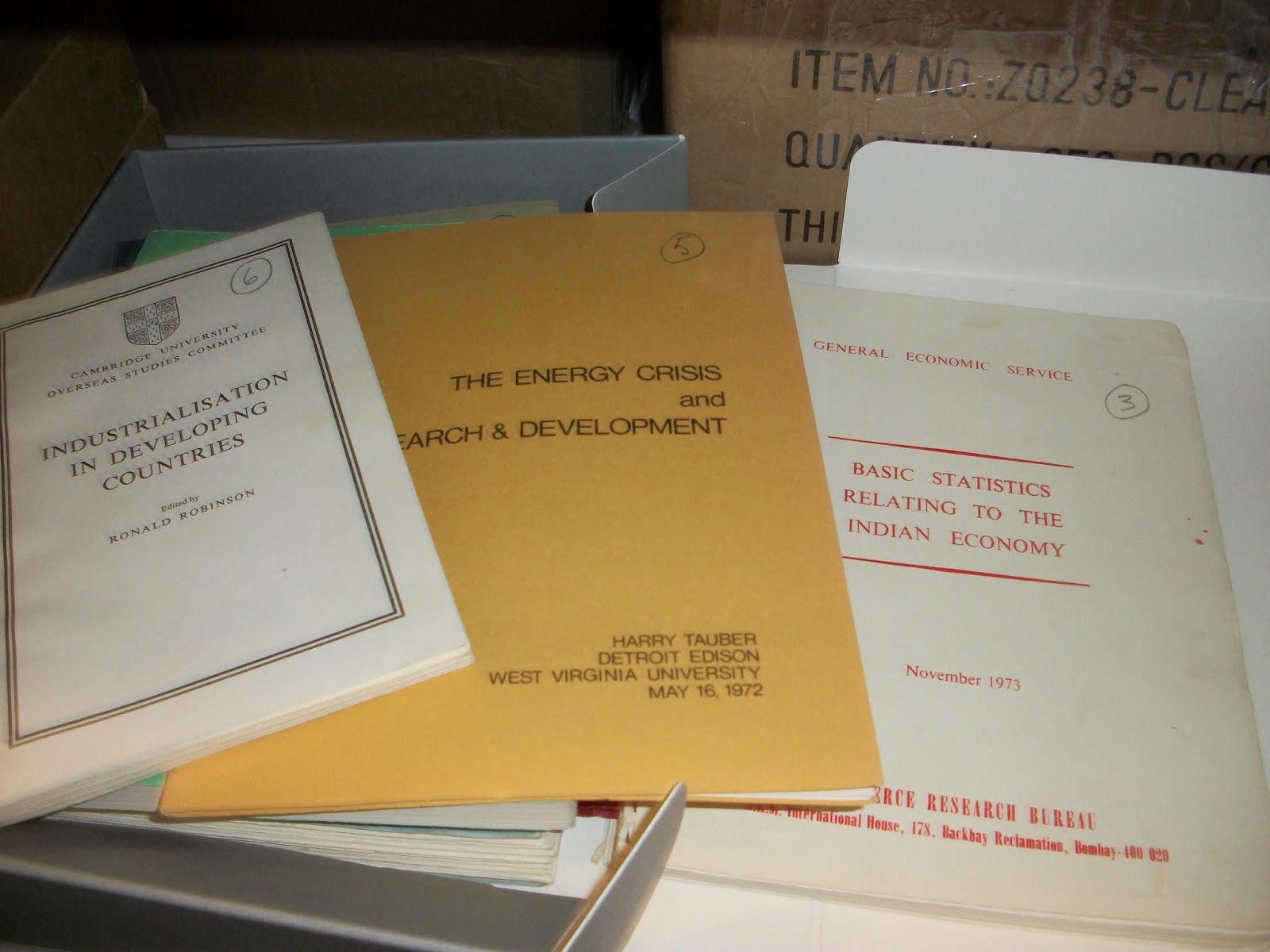 |
| A selection of Robinson Papers |
 |
| A selection of Robinson Papers |
and a collection of books, some of which are still held in the main library of the Centre and fifteen in the Archives sequence. Other more general books were given to Sidney Sussex College and can be found by using the keywords Provenance: bequeathed by Sir Austin Robinson on iDiscover
From 1926-28, when he went to India soon after marrying Joan (nee Maurice), he tutored the young Maharajah of Gwalior. In his mid-seventies he was Senior Adviser to the United Nations Advisory Team to ASEAN (the Association of South East Asian Nations).
Archive ROB 1 is a biography by H.M. Bull of Madhav Rao Scindia of Gwalior 1876 -1924 Gwalior : A.D. Press, 1926), the father of Robinson’s tutee. Archive ROB 13 is The Gwalior Annual Civil List : compiled in the Finance member's office Gwalior and published by authority, corrected up to 30th June 1927. (Lashkar : Alijah Darbar Press, 1927) and, unique to Cambridge, is
Archive ROB 5

Hindu fairy tales by Dewan Sharar, illustrated by Ernest Aris. (London : George G. Harrap, 1936.)
Other books in the collection reflect a general interest in India such as :
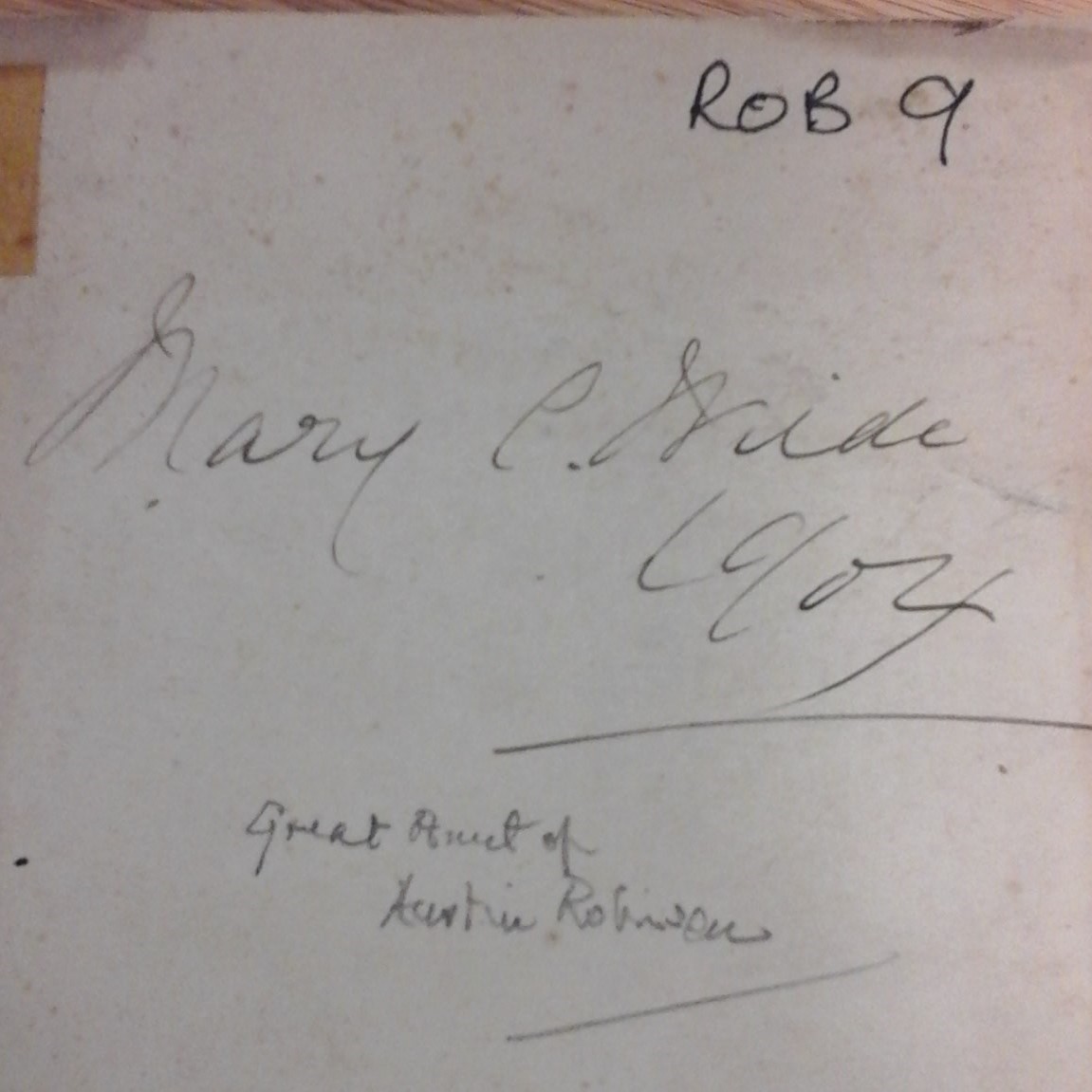 |
| Archive Rob 9 fly leaf |
Wednesday, 29 August 2018
New Book: 'Visual Histories of South Asia' by Annamaria Motrescu-Mayes and Marcus Banks (2018, Primus)
New Book: 'Visual Histories of South Asia' by Annamaria Motrescu-Mayes and Marcus Banks (2018, Primus)
We are delighted to announce the publication of 'Visual Histories of South Asia', edited by Annamaria Motrescu-Mayes and Marcus Banks (with a Foreword by Christopher Pinney). This volume is one of the first comprehensive contributions to the rapidly developing cross-disciplinary scholarship that connects visual studies with South Asian historiography. The key purpose of the book is to introduce scholars and students of South Asian and Indian history to a detailed evaluation of visual research methods as a valid research framework for new historical studies. The volume identifies and evaluates current developments in visual sociology and digital anthropology relevant to the study of contemporary South Asian constructions of personal and national identities. The thirteen contributions selected for this volume are of immediate relevance to visual theorists and historians, sociologists and cultural anthropologists, as well as to scholars of South Asian history and culture. The volume includes contributions by Denis Vidal, Marcus Banks, Josefine Baark, Thomas Simpson, Teresa Segura-Garcia, Annamaria Motrescu-Mayes, Imma Ramos, Xavier Guegan, Adrian P. Ruprecht, Aaron Bryant, Ronie Parciak, Souvik Naha, and Siddharth Pandey.
Reviews:
'This volume provides a rich feast of materials for anyone interested in the visual cultures and history of visual representation in South Asia and is notable as well for its fascinating exploration of the intersection of Western and local photographic practices’ – David MacDougall, Australian National University.
'This is a remarkable, genuinely interdisciplinary collection, and both a marvellously rich addition to the study of the life of visual images in South Asia, and a highly sophisticated contribution to debates of the interdisciplinary study of visual culture' – James Laidlaw, William Wyse Professor of Social Anthropology, Head of Division, Social Anthropology, University of Cambridge.
'This is an outstanding contribution to a timely and relevant focus on transregional visual history and historiography of South Asia. This rescaling of what is often times an India-centric visual history is accompanied by remarkably heterogeneous approaches from across disciplines and methods, challenging notions of political, cultural, religious or ethnic reifications. The book offers insights into original material and a framework of rich epistemologies, entanglements, relationalities and translations. It will encourage new generations of scholars to further push boundaries of established canons and exploring new frontiers of visual culture and history studies' – Christiane Brosius, Chair of Visual & Media Anthropology, Heidelberg Centre for Transcultural Studies, Heidelberg University.
'This is a unique and excellent contribution to the field of South Asian visual studies, art history and cultural analysis. This text takes an interdisciplinary approach while keeping its focus on the visual, on material cultural and on art and aesthetics. It brings together empirically rich and theoretically sophisticated analysis on representations from colonial and post-colonial eras ranging from colonial era photography to "tribal art," temple and video art. In doing so it bridges a major gap in our understanding of South Asia's modern history by using the idiom of visual culture and the politics of representation' – Kamran Asdar Ali, University of Texas at Austin
Link to online stores: https://amzn.to/2y2d2aE and http://www.primusbooks.com/showbookdetail.asp?bookid=202
Sunday, 15 July 2018
An architect's collection H.A.N. Medd
H.A.N Medd (September 21, 1892 - October 26, 1977) who assisted Sir Edwin Lutyens in in the
construction of Delhi gave maps and various papers to the Archives of
the Centre of South Asian Studies and a collection of 954 photographs which
cover New Delhi and India General from 1920 to 1975.
The 41 books which were given by him to the library have recently
been catalogued and can be searched on iDiscover under the classmark Archive MED. Seven titles are unique to the Centre including this portfolio of sketches :
 |
The architect's calendar : twelve architectural phantasies,
one for each month / drawn by Gavin Stamp. London : The artist, 1973. Archive
MED 41
|
Beautiful illustrations are also found in Poems of Nizami edited by Lawrence Binyon, London : Studio Ltd., 1928 Archive MED 25

and in Tales of Old Sind by C.A. Kincaid, London : Humphrey Milford, 1922. Archive MED 11, only held in the Centre. The illustrations are still in copyright so cannot be reproduced in this blog.
The Medd collection includes guides to museums, art history, wildlife and the history of mountaineering. The oldest book in the collection is T.H. Hendley, Handbook to the Jeypore museum, Calcutta : Central Press, 1895 (Archive MED 19) which includes 16 plates, including 3 collotypes, 2 floor plans, and 11 photochromolithographs, whilst Roy Craven, Concise history of Indian art, London : Thames and Hudson, 1975 (Archive MED 28) was purchased shortly before he died in 1977. The highlands of Central India : notes on their forests and wild tribes, natural history, and sport by James Forsyth was originally published in 1871, Medd's copy was published in London by Chapman and Hall in 1919 (Archive MED 16). Another copy was presented by Col. H.B. Hudson (Archive HUD 12).
The mountaineering books collected by Medd include Eric Shipton's Nanda Devi, London : Hodder, 1936 (Archive MED 35), H.W. Tilmann's Ascent of Nanda Devi, Cambridge: University Press, 1937 (Archive MED 33) and Kenneth Mason Abode of snow : a history of Himalayan exploration, London : Rupert Hart-Davis, 1955 (Archive MED 29). A previous blog discussed other mountaineering books held in the Archive collection.
Subscribe to:
Posts (Atom)