In the 1980's James Meston (QC 1996), the 3rd Baron Meston, gave to the Archives of the Centre of South Asian Studies over 40 books belonging to his grandfather, James Scorgie Meston (12 June 1865 – 7 October 1943)
Sir James S. Meston (1st Baron Meston) was a Member of the I.C.S., posted to N.W. Provinces and Oudh, 1885; Financial Secretary, 1899-1903; Financial Secretary to Government of India 1906-12; Lieutenant-Governor, United Provinces 1912-18; Finance Member 1918-19; Chairman, Committee on Financial Adjustments between Provinces and Centre 1920. November 1919 he became the Baron Meston of Agra and of Dunnottar, Kincardineshire and published Nationhood for India, 1931 held at Archive MES 22.
Tucked into the Indian Civil Service List for 1885 (Archive MES 38), with Meston’s pencil annotations,
is a pamphlet with the syllabus for the Civil Service of India examination held July 1885 for candidates selected in 1883,
including Languages according to posting, Law, History and Geography of India, Political economy and Natural Science. There is also a note under the heading Riding : “Candidates who have failed at the First and Second Examinations to satisfy the Commissioners of their ability to ride will be allowed a third trial at the time of their Final Examination”.
In this final examination James Scorgie Meston came 8th out of 28 candidates having taken papers in Hindi, Hindustani, Sanskrit and Zoology and some of the set texts he studied form part of the donation, including The Sakuntala in Hindi edited by Frederic Pincott, London : Wm. Allen, 1876 (Archive MES 42), Hindi Reader edited by Fitzedward Hall, Hertford : Stephen Austin, 1870 ; for the Persian paper, John T. Platts' translation of The Gulistan or Rose Garden of Sa'di, London : Wm. H. Allen, 1876 (Archive MES 46); for the Hindustani (as a second vernacular Paper) Bagh o Bahar edited by Duncan Forbes, London : Wm H. Allen, 1873 (Archive MES 47) and for Paper 2 on Indian Law, the penal code printed in H.A.D. Phillips Manual of Indian criminal law. Calcutta : Thacker, Spink, 1883. (Archive MES 39).
A listing of the Meston donation can be found by going to iDiscover selecting Advanced Search, then South Asian Studies from the drop down Library menu, Classmark from the Field drop down menu, then entering Archive MES next to Contains.
Sir James S. Meston (1st Baron Meston) was a Member of the I.C.S., posted to N.W. Provinces and Oudh, 1885; Financial Secretary, 1899-1903; Financial Secretary to Government of India 1906-12; Lieutenant-Governor, United Provinces 1912-18; Finance Member 1918-19; Chairman, Committee on Financial Adjustments between Provinces and Centre 1920. November 1919 he became the Baron Meston of Agra and of Dunnottar, Kincardineshire and published Nationhood for India, 1931 held at Archive MES 22.
Tucked into the Indian Civil Service List for 1885 (Archive MES 38), with Meston’s pencil annotations,
 |
| Archive MES 38 |
is a pamphlet with the syllabus for the Civil Service of India examination held July 1885 for candidates selected in 1883,
 |
| Archive MES 38a |
In this final examination James Scorgie Meston came 8th out of 28 candidates having taken papers in Hindi, Hindustani, Sanskrit and Zoology and some of the set texts he studied form part of the donation, including The Sakuntala in Hindi edited by Frederic Pincott, London : Wm. Allen, 1876 (Archive MES 42), Hindi Reader edited by Fitzedward Hall, Hertford : Stephen Austin, 1870 ; for the Persian paper, John T. Platts' translation of The Gulistan or Rose Garden of Sa'di, London : Wm. H. Allen, 1876 (Archive MES 46); for the Hindustani (as a second vernacular Paper) Bagh o Bahar edited by Duncan Forbes, London : Wm H. Allen, 1873 (Archive MES 47) and for Paper 2 on Indian Law, the penal code printed in H.A.D. Phillips Manual of Indian criminal law. Calcutta : Thacker, Spink, 1883. (Archive MES 39).
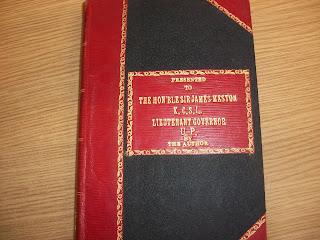
In the course of his career, James, 1st Baron Meston received various presentation volumes including The History of the Taj by Md. Moin-Ud-Din, Agra : Moon Press, 1905 (Archive MES 30)

The growth of currency organisations in India by Alakh Dhari, Bombay Chronicle Press, 1915 (Archive MES 13)
 |
| Inscription reads To The Hon'ble Sir James Meston from the author Feby 1915 |
and the autobiographies of Nawab Shah Jahan Begam and Nawab Sultan Janan Begam of Bhopal
Archive MES 11 and 25)
 |
| Shah-Jahan Begum, ruler of Bhopal (1838-1901) Raja Deen Dayal & Sons, photographer |
A listing of the Meston donation can be found by going to iDiscover selecting Advanced Search, then South Asian Studies from the drop down Library menu, Classmark from the Field drop down menu, then entering Archive MES next to Contains.


