We are the South Asia Archive & Library Group, representatives of libraries, archives and other institutions in the United Kingdom with some degree of specialisation in South Asian Studies. Please check our blog regularly to see our latest news (plus new links and blogs we're following - see below)! Or subscribe for regular email updates.
Friday, 16 August 2013
Southern Indian Material at the Henry Martyn Centre, Westminster College
A guest post by Lucy Hughes, Archivist of the Henry Martyn Centre in Cambridge.
Readers of the SAALG blog may be interested to learn about the collection of material relating to missionary work in Southern India which is held at the Henry Martyn Centre, Westminster College. The items in this miscellaneous collection of books, articles and pamphlets were connected with the Reverend R. B. Budgett and range in date from 1913 to 1958.
The ‘Indian Liturgy’ (shown in the scanned image) is an abridged edition, revised in 1942, of the original order for the administration of holy communion sanctioned in 1922 by the Episcopal Synod of India for experimental use in the diocese of Bombay. In 1933 the order was given authorisation for use in any diocese of the Church of India, Burma and Ceylon. It is 2/4 in the South India collection. Within the same collection is to be found a folder of items relating to the Dornakal diocese. This folder includes a pamphlet entitled ‘Jungle Wanderings in the Diocese of Dornakal’ by Captain Hayne, undated (South India 3/7). Printed by the Church Army Press in Oxford, it is 12 pages long and contains 7 photographs of village life accompanying the detailed descriptions of life in this remote rural district, and the gradual infiltration of Christianity into the community.
Another item of particular interest is a note relating to a book entitled Andhra Christian Lyrics (South India 4/1). Andhra Christian Lyrics is an anthology published in Madras, 1937, of Christian verses popular in the Andhra region: they are printed in Hindi. According to a note (South India 2/8) found in the same collection, number 77 is the most precious of the lyrics in the volume. A story about its composition is recited in the note:
‘It is on God’s love and was composed when the author Gollapalli Nathaniel was bound in stocks by the enemies of the Christian religion. Gollapalli Nathaniel was a voluntary Evangelist. He learnt to read and write only after he was baptised with his wife in 1862. Constrained by the love of God he went about preaching the Gospel in the villages. In one of his preaching tours of 1869 the high caste Hindus of Nuramanda objected to his preaching in their streets, and had him put in stocks. Some women who took pity on him begged the Hindus in vain to give him food that night. In spite of pain all over the body Nathaniel composed this lyric on God’s love and sang it to the people who came to see him the next morning … The lyric is prescribed as the first lesson to all people preparing for baptism. It is taught to them with full explanation from the Bible. It is sung by Christians of all denominations in Andhra desa and almost all six lakhs of Christians in the Telugu area know it by heart. During Hindu festival times the lyric is printed on a separate handbill and is distributed to all non-Christians.’
Monday, 5 August 2013
Researching developing cities
Researchers interested in issues relating to the growth of cities in south and south-east Asia may be interested in a new research group, recently established at the University of Cambridge, Cities South of Cancer (CSC). The group is currently studying four cities: Buenos Aires (Argentina), Cali (Colombia), Jakarta (Indonesia) and Khulna (Bangladesh).
Researchers explore issues to do with globalisation and architecture, poverty and urban informality, urban growth and governance, amongst other major themes. Research extends across disciplinary boundaries constantly inviting collaborations with sociologists, anthropologists, cultural theorists, urban planners, historians, lawyers and engineers. CSC emerges as a platform for interdisciplinary and cross-sector collaboration whose aim is to develop new forms of urban practice in the developing world. Group members may be contacted at citiessouthofcancer@aha.cam.ac.uk
Friday, 2 August 2013
Not Orville and Wilbur
![]() |
| MS Add.1688, f. 19v (detail). Representation of the goddess Mayūrī from an 11th-century manuscript of the Pañcarakṣā, bought by Daniel Wright in 1873-6. |
In the world in general mention of the Wright Brothers brings to mind the pioneers of controlled powered manned flight, Orville and Wilbur Wright. In the Sanskrit world, the Wright Brothers suggest instead the beginnings of one of the most important Sanskrit manuscript collections in the world.
Cambridge University Library’s South Asian collections grew in the 1870s when one brother Daniel Wright, surgeon to the British Residency at Kathmandu, Nepal from 1866 to 1876, collected a large number of Sanskrit manuscripts on the suggestion of his brother in Cambridge, William Wright, Sir Thomas Adams’s Professor of Arabic from 1870. Their father had worked for the East India Company and William was born in Nepal. William Wright donated many Islamic manuscripts to the Library and arranged the purchase of a significant Syriac collection.
The first Sanskrit manuscripts were commissioned copies, transcripts of early manuscripts. It was only as the project progressed that it became clear that buying manuscripts of an early date that would be taken out of use when modern copies were made was the way forward. Many purchases were made through Pandit Gunanand of the Residency, with whom Daniel Wright wrote a history of Nepal (Cambridge, 1877).
We have a price list in Daniel Wright’s hand (classmark ULIB 7/1/4) showing that MS Add. 1585–1677 were purchased for £429/11/-. The famous illustrated Perfection of Wisdom (MS Add. 1643) dated 1015 cost £25! The same list shows that Daniel Wright was also sending unbound Tibetan block-printed books and Tibetan manuscripts.
South Asian manuscripts in Cambridge University Library comprise more than one thousand documents in Sanskrit and other South Asian languages, written in various scripts on different materials, such as birch-bark, palm-leaf and paper. Many have wooden covers, some lavishly illustrated. On some there are traces of offerings made in religious ceremonies: rice, sandalwood dust and red and yellow powders. The Buddhist manuscripts were catalogued by Cecil Bendall in the late 19th century (Cambridge, 1883). What Daniel Wright collected is much wider than the Buddhist core of the collection and includes works of great rarity in different genres and on a host of subjects. Among them are some of the oldest extant manuscripts from South Asia, dating from the last centuries of the first millennium CE, collected in Nepal, the only region of the Indian subcontinent where the climate allows their survival for more than a few centuries.
This collection is now being worked on by the Sanskrit Manuscripts Project which began in November 2011, funded by an Arts and Humanities Research Council grant. The manuscripts will be catalogued and many will be digitised. Results will be collected in a multimedia archive and the records will be searchable online through the Library’s online digital library: http://cudl.lib.cam.ac.uk/. Many are already available.
This in turn is sparking a collaborative effort with Sanskritists in the UK and abroad. Research findings will be presented through academic journals and other publications, as well as in international workshops focusing on some of the religious and intellectual traditions that have played a key role in South Asian civilisation.
For more information, see the Sanskrit Manuscripts Project webpage, which has details of current work and associated events.
Craig Jamieson
South Asian, Tibetan and Southeast Asian Department, Cambridge University Library
Email: southasian@lib.cam.ac.uk
Tuesday, 30 July 2013
Pamphlets from the former India Office Library recently added to the British Library's Online Catalogue
The British library has recently added catalogue records for a collection of about 540 pamphlets, received in the former India Office Library during the 1920s and 1930s. Catherine Pickett has written a piece for the Electronic British Library Journal which reveals that the majority of the pamphlets are South Asian imprints, some of which are very rare. For the full text of the article follow the below link
http://www.bl.uk/eblj/2012articles/article12.html
Labels:
British Library,
India Office Library,
pamphlets
British Library European Studies Blog - Multiculturalism in 18th Century Portuguese India?
Readers of the SAALG blog may also be interested in a post recently added to the British Library European Studies Blog by Barry Taylor, Curator of Hispanic Studies. He discusses a Portuguese pamphlet in the British Library which reported the 'happy news of the conversion of a yogi, who in the religious house of Bom Jesus in Goa received holy baptism on 8 September 1735' (Lisboa Occidental: na Officina Joaquiniana da Musica, 1737) BL shelfmark: RB.23.a.21030.
For the full post including an image follow the link below:
http://britishlibrary.typepad.co.uk/european/2013/07/multiculturalism-in-18th-century-portuguese-india.html
For the full post including an image follow the link below:
http://britishlibrary.typepad.co.uk/european/2013/07/multiculturalism-in-18th-century-portuguese-india.html
Sunday, 23 June 2013
Duke University awarded grant from the British Library's Endangered Archives Programme
![]() |
| Menri Monastery in Northern India possesses the world's largest collection of manuscripts relating to Bön, the pre-Buddhist religion of Tibet. All photos by Edward Proctor. |
![]() |
| Pechas, or traditional Tibetan books, consist of loose leaves of handmade paper wrapped in cloth, placed between wooden boards, and secured with a belt. |
Wednesday, 22 May 2013
SAALG 89th Conference - South Asian Arts and Crafts - Norwich - Friday 5th and Saturday 6th July
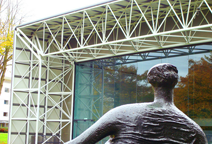
SAALG is very pleased to announce that its next conference will take place in Norwich on Friday 5th and Saturday 6th July at the Sainsbury Centre for Visual Arts and the SADACC Trust.
![]() |
| Image copyright of SCVA University of East Anglia |
The conference will explore South Asian arts and crafts and will include talks on:
- ‘Early British Observations: The Madras and Environs Album 1804-1808’ by Diana Grattan (Collection Curator, The SADACC Trust)
- ‘Indian anthropology and it’s archive’ by Dr Dan Rycroft (Lecturer in the Arts and Cultures of Asia at the School of World Art Studies, UEA)
- 'Networked Artist-led Initiatives in South Asia' by Emily Crane (PhD Candidate, Sainsbury Institute for Art, University of East Anglia).
There will also be presentations by Taylor and Francis of their new ‘South Asia Archive’ and Adam Matthew Digital of the digital archive of 'Foreign Office Files for India, Pakistan and Afghanistan, 1947-1980'
![]() |
| Image copyright of SADACC Trust |
To attend our Friday programme the fee is £20.00 payable on the day (including lunch and refreshments, but excluding the conference dinner) and to attend the Saturday programme it is an additional £10.00. We encourage you to bring guests, family or friends to our conference dinner and Saturday tour, please just let us know when you book.
We are very grateful to Adam Matthew Digital for sponsoring our Drinks reception and Taylor and Francis for a donation to help SAALG with running costs for the conference.
For a full programme (including further details about accommodation options and conference dinner) or to make your booking please get in touch with Helen Porter hp@royalasiaticsociety.org by Friday 28th June.
Friday, 17 May 2013
Searching for Sikh Soldiers on British Medals
Enjoy a short talk, viewing session and tour of the Fitzwilliam Museum’s Images of Empire
display. This special event provides an opportunity to take a closer
look at a selection of rare silver medals and see beautiful artwork
relating to Sikh soldiers who fought for and against the British during
the nineteenth century.
Open to all. Refreshments provided.
When? Sat 15 June 2013 | 14:00 to 15:00
Where? Seminar Room, Fitzwilliam Museum, Trumpington Street, Cambridge, CB2 1RB
Free, but advanced booking recommended. Please email aj431@cam.ac.uk to book a place.
Open to all. Refreshments provided.
When? Sat 15 June 2013 | 14:00 to 15:00
Where? Seminar Room, Fitzwilliam Museum, Trumpington Street, Cambridge, CB2 1RB
Free, but advanced booking recommended. Please email aj431@cam.ac.uk to book a place.
Friday, 10 May 2013
Scholars without Borders
Just a short post to introduce you to the blog, Scholars without Borders, http://swblogs.blogspot.co.uk/ . I have added a link to it in our Blog List (scroll down and it is on the right hand side of this post).
Scholars without Borders is a blog written by a group of academics based at the Jawaharlal Nehru University in New Delhi, who are keen to promote academic books published in India to a wider audience. It provides timely posts on new books, but also on journals, documentaries and reports.
Monday, 6 May 2013
Tagore goes online in English and Bengali
Bichitra, (http://bichitra.jdvu.ac.in/index.php) an online variorum of the works of Rabindranath Tagore, will be launched on 8 May 2013. According to Abhijit Gupta, Associate Professor of English, Jadavpur University, and Director, Jadavpur University Press, it is the largest integrated site on any author, containing nearly all of his writings in Bengali and English, in all their versions, from manuscript to print, comprising 47,520 pages of manuscript and 91,637 pages of print. Other features of the website include text files of every version of each of Tagore's works, a unique collation software (the first in Indic script), a search engine that helps locate any word or phrase used in his works, a checklist of all Tagore's manuscripts and a comprehensive bibliography of Tagore's works. The website can be navigated in three languages--English, Bengali and Hindi. The project was executed in two years by the School of Cultural Texts and Records, Jadavpur University, and was led by Sukanta Chaudhuri, emeritus professor at Jadavpur University.
Friday, 3 May 2013
Rosemary Seton Talk and Book Launch at the RAS Friday 10th May
Rosemary Seton would like to invite SAALG members to an illustrated talk she will be giving at the Royal Asiatic Society next Friday 10th May at 18.30 on her recently published book Western Daughters in Eastern Lands. There will be short contributions from Dr Emily Manktelow (University of York) and Dr Frances Wood (British Library) followed by a wine reception.
There is full information about the event and location on the Royal Asiatic Society blog
Labels:
Book Launch,
India,
missionaries,
Rosemary Seton,
Royal Asiatic Society
Thursday, 25 April 2013
Why South Asia? British Academy, 17 May 2013
The conference Why South Asia? is to be held at the British Academy on
17 May 2013 from 9.45am until 5.30pm.
The British Academy is running a series of events to explore the current state and continuing importance of South Asian Studies in the UK. The series opened with a lively roundtable discussion about the present state of the academic study of South Asian Studies in the UK and included an interdisciplinary conference on Space and Spatiality in South Asia (see http://www.britac.ac.uk/intl/Space_and_Spatiality_in_South_Asia_Conference.cfm).
As the third of these events, Why South Asia?draws upon debates in the two earlier events to assess the wider relevance and value of South Asian Studies today. It looks beyond the South Asian Studies ‘community’ in the UK to seek to examine what on-going interest in the South Asia region means to a wider constituency of ‘users’ -- in government and NGOs, in research institutions, publishing and the media. It explores the relevance of the concept of South Asia to the social sciences and to issues of policy and engagement in the UK, and asks what can be gained from the study of South Asia elsewhere in Europe and experience and in South Asia itself. Speakers include Jo Beall from the British Council; Amita Batra from Jawaharlal Nehru University; Gita Dharampal-Frick from Heidelberg University; Lucy Rhymer of Cambridge University Press; Nira Wickramasinghe from Leiden University; and Penny Brook of the British Library. The provisional programme is set out below.
The conference is free and open to the public but places will be limited and prior registration is, therefore, essential. Please circulate details among your contacts. To register, or for further information, please email Debbie Soothill at d.soothill@britac.ac.uk.
Dr. Debbie Soothill
International Senior Policy Adviser
The British Academy
10-11 Carlton House Terrace
London SW1Y 5AH, UK
Tel: +44 (0)20 7969 5276
Email: d.soothill@britac.ac.uk
The British Academy is running a series of events to explore the current state and continuing importance of South Asian Studies in the UK. The series opened with a lively roundtable discussion about the present state of the academic study of South Asian Studies in the UK and included an interdisciplinary conference on Space and Spatiality in South Asia (see http://www.britac.ac.uk/intl/Space_and_Spatiality_in_South_Asia_Conference.cfm).
As the third of these events, Why South Asia?draws upon debates in the two earlier events to assess the wider relevance and value of South Asian Studies today. It looks beyond the South Asian Studies ‘community’ in the UK to seek to examine what on-going interest in the South Asia region means to a wider constituency of ‘users’ -- in government and NGOs, in research institutions, publishing and the media. It explores the relevance of the concept of South Asia to the social sciences and to issues of policy and engagement in the UK, and asks what can be gained from the study of South Asia elsewhere in Europe and experience and in South Asia itself. Speakers include Jo Beall from the British Council; Amita Batra from Jawaharlal Nehru University; Gita Dharampal-Frick from Heidelberg University; Lucy Rhymer of Cambridge University Press; Nira Wickramasinghe from Leiden University; and Penny Brook of the British Library. The provisional programme is set out below.
The conference is free and open to the public but places will be limited and prior registration is, therefore, essential. Please circulate details among your contacts. To register, or for further information, please email Debbie Soothill at d.soothill@britac.ac.uk.
Dr. Debbie Soothill
International Senior Policy Adviser
The British Academy
10-11 Carlton House Terrace
London SW1Y 5AH, UK
Tel: +44 (0)20 7969 5276
Email: d.soothill@britac.ac.uk
British Academy
Why South
Asia? The Relevance of South Asian Studies Today
A
Conference to be held at the British Academy, 10-11 Carlton House Terrace,
London SW1Y 5AH on 17 May 2013
Draft programme
9.45 Coffee
10.00 Introduction
and Welcome
Helen
Wallace, Foreign Secretary, British
Academy
10.15 Why
South Asia?
David Arnold, Chair, South Asia Panel,
British Academy
10.30
- 12.15 Session 1: South Asia and the
Social Sciences
Chair: Lawrence Saez, Politics and
International Studies, SOAS
Matthew
McCartney, Director, Contemporary
South Asian Studies Programme, Oxford
Mukulika
Banerjee, Anthropology, LSE
Kunal Sen, Manchester, Institute for Development Policy and
Management, University of Manchester
12.15-1.00 Lunch
1.00-3.00 Session
2: The Uses of South Asia
Chair: Barbara
Harris-White, Development Studies, Oxford
Penny Brook, Lead Curator, India Office Records, British Library
Lucy Rhymer, Commissioning Editor, Asian Studies, Cambridge
University Press
Jo
Beall, Director, Education and
Society, British Council
Mark
Robinson, Research and Evidence
Division, DFID
Yolanda
Foster, South Asia Team, Amnesty
International
3.00-3.30 Tea
3.30-4.45 Session
3: International Perspectives
Chair: Christopher
Bayly, Director, Centre of South Asian Studies, Cambridge
Gita Dharampal-Frick, South Asia Institute, Heidelberg
Nira Wickramasinghe, Asian Studies, Leiden
Amita Batra, School of International Studies, JNU, Delhi
4.45-5.30 Closing
Discussion
Chair: David
Arnold
Labels:
British Academy,
conferences,
South Asian Studies
Tuesday, 2 April 2013
Amateur film-making in post-colonial India
"Le Centre d’Études de l’Inde et de l’Asie du Sud (CEIAS), Paris, is organising a seminar on the theme of contemporary amateur filmmaking in India as part of its research programme ’Cultural industries, artistic and literary Indian scenes’. The seminar, titled “An intimate craft of national memory: amateur filmmaking in post-colonial India” will be presented by Annamaria Motrescu-Mayes (CSAS, University of Cambridge) on Thursday 4th April 2013.
For details, see CEIAS poster: http://ceias.ehess.fr/docannexe.php?id=2030
Labels:
amateur films,
Dr Annamaria Motrescu-Mayes,
film making,
India
Thursday, 28 March 2013
Shot in the arm for Medical History of British India website
A new collection of medical documents from the British Raj is now available to browse and search on the Medical History of British India website. 'Medicine - Vaccination' shows British efforts to vaccinate the Indian population against smallpox using the latest 19th and 20th century western scientific techniques. Over 60 reports reveal the complex nature and the scale of ambition of the vaccination programme in India as well as the conflict between western colonial medicine and indigenous society, culture and systems. The project was generously funded by a grant from the Wellcome Trust.
Wednesday, 27 March 2013
Next SAALG Conference Friday 5th and Saturday 6th July 2013 - Norwich
SAALG's 89th conference will take place in Norwich on Friday 5th and Saturday 6th July so please add the dates to your diaries. We will be focusing on South Asian Arts and Crafts over the two days - the main talks on Friday will be held at the Sainsbury Centre for Visual Arts at the University of East Anglia on Friday, followed by a visit to the SADACC Trust (South Asian Decorative Arts and Crafts Collection) and a conference dinner in Norwich. On Saturday we will have the opportunity to view the galleries at the Sainsbury Centre.
![]() |
| Sainsbury Centre for Visual Arts, University of East Anglia, Norwich. Image copyright of University of East Anglia. |
![]() |
| The SADACC Trust, Norwich |
Participants will be welcome to take part in one or both days and full details of the talks, schedule for the two days and accommodation options will be sent out in the near future.
If you have any questions in the meantime please don't hesitate to get in touch with the SAALG Chair, Helen Porter hp@royalasiaticsociety.org Tel: 0207 391 9424.
Subscribe to:
Posts (Atom)